Release workflow
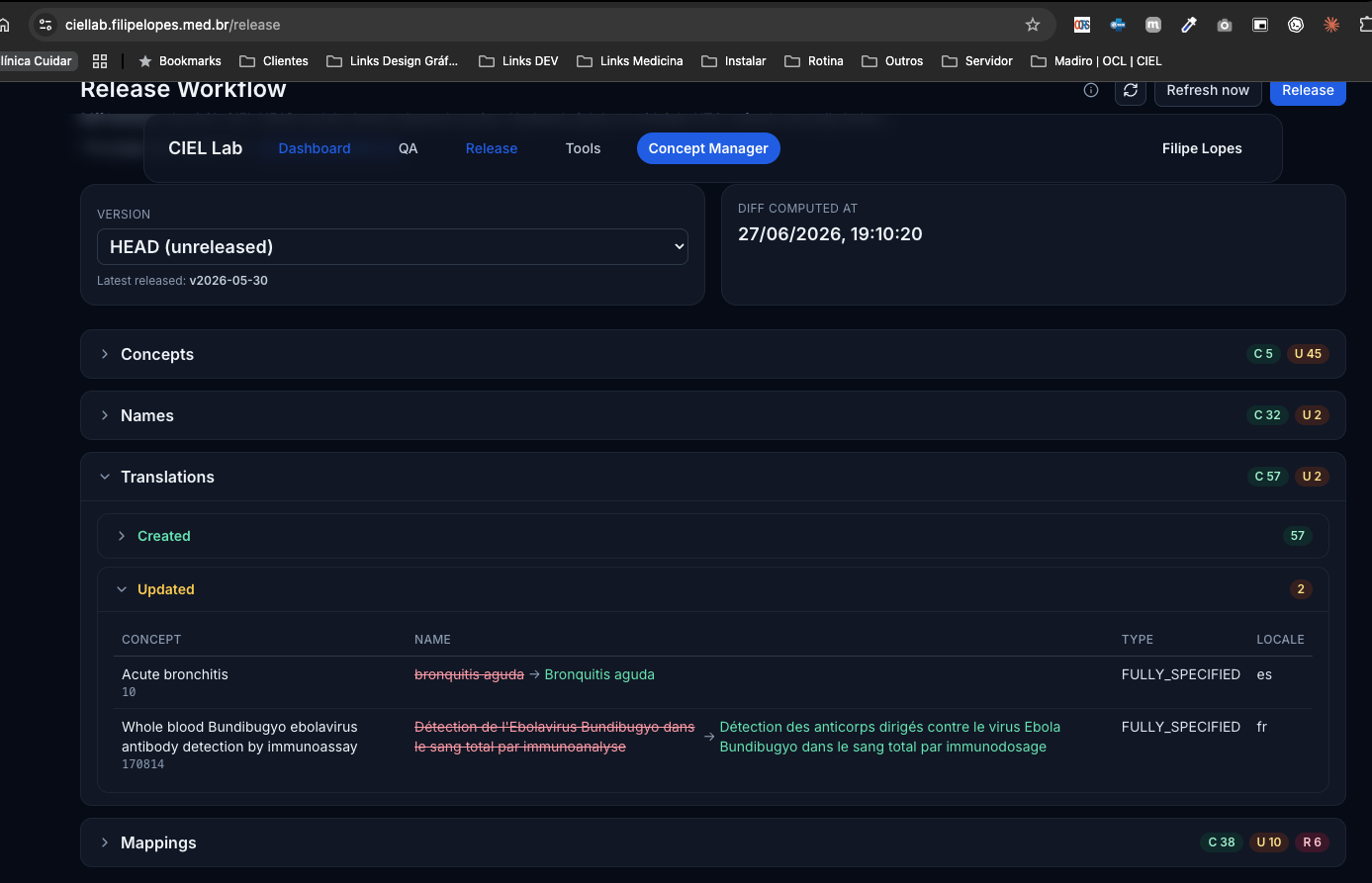
The Release page coordinates the transition from a changing CIEL HEAD to a reviewed release and its downstream artifacts.
Before starting
Confirm all of the following:
- the intended OCL source is selected;
- HEAD refresh and derived indexes have completed;
- the latest Bulk Validation report targets HEAD;
- the report is less than 24 hours old and has zero errors;
- active worklists have been reviewed or explicitly deferred;
- a database and OCL recovery plan exists for the release operation.
Understand the comparison
The page compares HEAD with the latest released version and groups changes such as:
- concepts created, updated, removed, or retired;
- names, descriptions, and translations changed;
- mappings created, updated, removed, or retired.
The displayed comparison is derived state. Reload reads the current cached comparison. Refresh pulls a newer OCL HEAD and may rebuild the cache and index before the diff becomes available.
Create a release
- Reload and review the full staged-change summary.
- Drill into every unexpected category.
- resolve or document outstanding QA findings.
- Confirm the release identifier and description.
- Start release creation.
- Keep browser notifications enabled if you want completion feedback while working elsewhere.
- Verify the newly created OCL version.
- Generate and inspect downstream artifacts.
Artifacts
Background tasks can produce:
- a Markdown change report;
- an OpenMRS-compatible SQL artifact;
- Liquibase Runner publication output;
- supporting downloads stored in S3-compatible object storage.
Artifact generation can outlive the browser request. Use task state and the artifact record instead of assuming a closed browser canceled the job.
Failure recovery
If the release job fails:
- do not start a second release immediately;
- inspect whether OCL already created a partial or complete version;
- inspect the background task and artifact logs;
- preserve the failed run record;
- restore or retry only after the actual external state is known.
Release operations are intentionally conservative. A clean diff and current QA report are more valuable than speed.